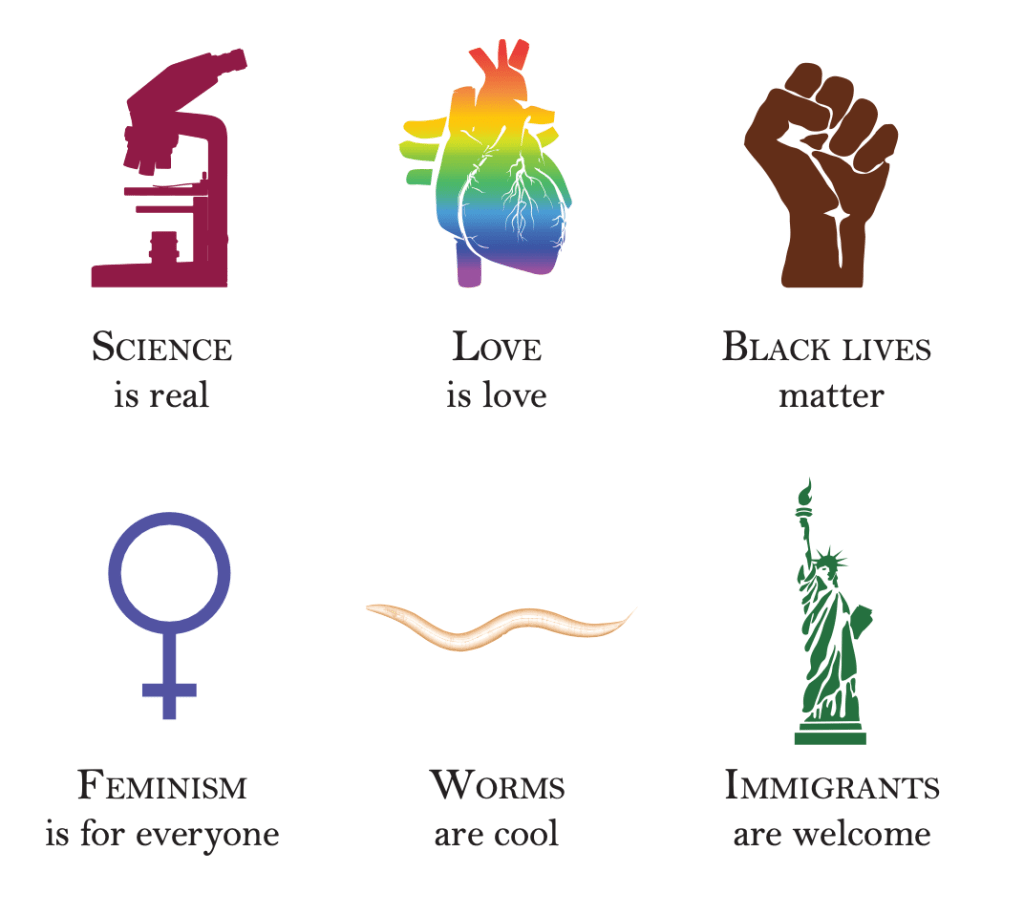
Image credit: adapted from Sammy Katta.
Equity, Diversity and Inclusivity in Science
2026. Co-founder of the EDI community library at the Biodiversity Research Centre, University of British Columbia, Vancouver, Canada.
2025. Member of the “Disabled In STEM Mentorship programme“.
2021. Starting member of the Portuguese EDI project ”Sci do Armário”.
Outreach and Science Communication
2026. Silva, LM. Small organisms, Big impacts (Pequenos organismos, Grandes impactos). Cultural week organised by ‘Externato Senhora do Carmo’ High School, Porto, Portugal.
2026. Silva, LM. How parasite evolution changes mosquito biology and the survival of future infections. Kudos.
2025. Education and Outreach Committee Member, SORTEE (Society for Open, Reliable, and Transparent Ecology and Evolutionary Biology).
2025. Silva, LM. Controlling the controller: suppressing microsporidia in their mosquito hosts. Kudos.
2025. Silva, LM. How do parasites manipulate their hosts — and what can we do with that knowledge? Kudos
2025 Silva, LM. When parasites wait to transmit, they become deadlier — and not only the time within the host matter. Kudos.
2025 Silva, LM. What if transmission isn’t a single event, but an evolving ecological process? Kudos.
2024 Silva, LM. Swimming in bacteria: How exposure to Pseudomonas shields mosquitoes from insecticide, Nature Ecology and Evolution Community.
2022 Silva, LM, Hidalgo, BA. How dissecting pathogen virulence can help predict the outcome of infection, Nature Microbiology Community.
Science Culture and Advocacy
2026. Travers-Cook T, Silva LM, Li J, Higgins C, Cornet C, Zeferino TG, Nath A, Gonzalez-Gonzalez E, Beck J, & Owens A. Promoting academic agency to empower early-career researchers. 2026. Trends Open.
2025. Silva LM. 2025. Scientific mobility in microbiology – 7. Trends in Microbiology.
2025. Peer committee member, “C. elegans Mentor-Match programme“.
I believe science should be a space where everyone feels safe, heard, and represented. Science and society thrive when we bring together diverse perspectives—across ethnic, social, and cultural backgrounds—and encourage open discussion.
There’s also a growing gap between scientific research and how it’s communicated to the world. Bridging that gap is more urgent than ever.
Hence, I’m always open to initiatives that promote diversity, inclusion, global change, and rethinking how academia works. If you’re working on something like this or just want to chat—feel free to drop me an email!

